
Guest Writer Heather Marshall Print Version
For nearly three years, all five subwatersheds in the Battle River watershed have remained under a Water Shortage Advisory (since May 31, 2023). As of mid-March, the basin is in Stage 2 (Moderate Drought), as defined in the Alberta Drought Response Plan.
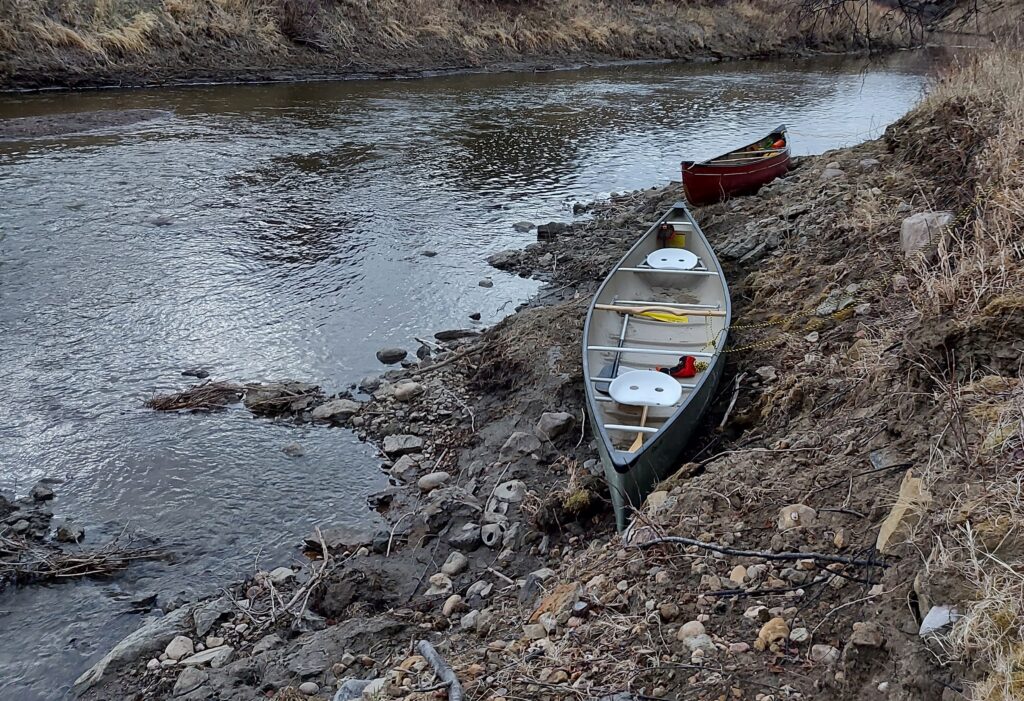
For landowner Susan Kokas, the shift in the past few years has been striking. Growing up along the Battle River and returning in 2020, she remembers how during her first year back heavy spring runoff flooded her basement. But by late summer in 2024 and 2025, the river had stopped flowing. As she walked on the riverbed in the fall of 2025, she recalls, “It was bone dry and weeds were everywhere. There were dead clams, dead grasses, and no ducks. It was sad indeed.”
 Prairie-fed watersheds like the Battle respond differently to drought than mountain-fed systems. Because they rely on precipitation, a lack of snow or rain can quickly lead to low flows, while mountain systems with deeper snowpack buffer variable flow.
Although conditions vary across the watershed, municipalities, water managers, and agricultural producers are adapting where possible, while closely watching how spring weather unfolds.
———————————————————-
Environmental and on-the-ground impacts
For agricultural producers, drought impacts are varied and complex.
In the eastern part of the watershed, Agricultural Fieldman Shelby Oracheski from the MD of Wainwright says surface water sources like sloughs and dugouts are under stress. As they dry up, livestock producers are sometimes forced into costly alternatives, such as drilling new pasture wells. While crop yields were generally strong last year in the Wainwright region, pastures and forage fields were hit hard, with some producers reporting just 30–40% of typical hay yields and poor regrowth after grazing.
Round Hill farmer Kyle Nahirniak says compaction from minimal till seeding and extreme practices has limited root development, especially in poorer soils. Newer forage stands are still producing, while older and native stands have declined. “April and May have been very dry the last ten years and that has had a negative impact on the stands that later rains can’t always fix.” Heavy rain is also not necessarily helpful in a drought. Dry soils absorb less, so storms often lead to runoff and flooding instead of restoring moisture levels. Nahirniak adds, “While precipitation has been a little below average it has been the extremes that cause the most grief.” Drought also limits root penetration and sudden heavy rain can drown shallow roots.
Alberta’s water shortage staging also highlights concerns about water quality in connection with ecology. Lower flows and higher temperatures warm rivers, reduce dissolved oxygen, and increase salinity, which puts stress on fish and aquatic life. Low flows also let sediments and pollutants accumulate, which storms can flush downstream, creating water quality risks.
Lakes, wetlands, and low-flow river sections of the watershed are especially vulnerable to drought because their capacity to dilute pollutants is reduced when water levels are lower. Conditions can vary widely, as in October 2024, when upstream sections of the Battle recorded zero flow, while downstream sections near the Saskatchewan border continued to flow.
Bradley Peters, Executive Director of the Alberta Lake Management Society, says rising total dissolved solids (TDS) is one indicator of drought stress. “Increasing TDS trends observed in many Alberta lakes may reflect evaporative water losses associated with prolonged dry conditions.” Shallow lakes are particularly at risk. “Lakes with gradual, shallow bathymetry are especially vulnerable to drought, as even modest drops in water level can result in significant horizontal shoreline retreat.”
———————————————–
Drinking water and management
Managing drinking water during drought is complex. Alberta’s system follows a “first in time, first in right” approach, where senior licence holders have priority to divert water. During low flows, flexibility comes through voluntary sharing, staged restrictions, and suspending temporary licences
At the water treatment level, Leonel Tobias, Operations Supervisor with Aquatera in Wetaskiwin, says “from an operational standpoint, our protocols remain the same.” While hot, dry conditions can increase algae and require additional treatment, Tobias says modern systems are designed to maintain water safety.
Wastewater management is also critical because treated releases help sustain downstream flows and water availability. Provincial guidance recommends pre-release sampling and analysis during drought to ensure treated effluent does not create unintended impacts in low-dilution conditions.
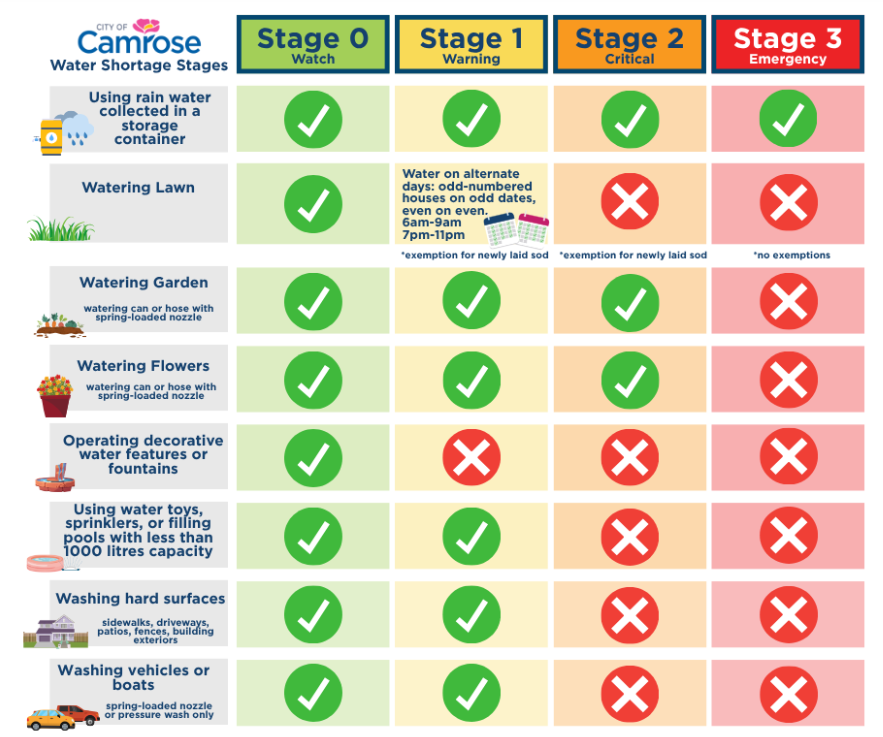
At the City of Camrose Manager Malcolm Boyd closely monitors water levels for the City’s water supply. In the current drought, DriedMeat Lake’s winter levels are the lowest they’ve been since 2009, when the weir was raised at DriedMeat Lake. A Water Shortage Response Plan outlines trigger points for when the reservoir storage drops below a certain point, resulting in water use restrictions for residents and businesses.
Stage 1 begins when the City’s model predicts less than 120 days storage until the level is reached where the first water licence is at risk of being cut off by the province, and the model predicts less than 120 days of raw water storage. Stage 1 includes minor outdoor water use restrictions, as residents of the City have experienced the past three summers in Camrose.
Boyd says the City recently received funding to study potential alternative water sources through the Capital Region Southwest Water Services Commission (CRSWSC). The study, being conducted by Associated Engineering, is examining the feasibility of accessing water from the North Saskatchewan River through EPCOR and the CRSWSC.
“We’re expecting to see drafts from that this summer,” Boyd says, noting that the project would involve significant infrastructure upgrades and remains in early stages.
In Beaver County, Agricultural Fieldman Jonathan Cuthbert says a Surface Water Management Study is nearing completion. It will map water movement, assess drainage infrastructure, and inventory wetlands. The study aims to find practical ways to manage flooding and drought, using wetland inventories to guide restoration and identify potential non-potable water sources. The study and strategy are expected later this summer.
In 2024, the Town of Viking opened a Seasonal Raw Water Pumping Station, safeguarding the town’s water supply while providing an alternative source for agriculture. As one of several communities in the watershed that already gets its potable water through EPCOR, the town was maintaining licences on two reservoirs south of town for emergency use. Old infrastructure from the reservoirs was re-purposed to give farmers access to raw filtered water for field operations, while preserving the town’s treated water supply for residential and livestock use.
——————————————————-
Agricultural stewardship and adaptation
Across the watershed, communities and producers are continually adapting for both flood and drought conditions.
For long-time producers, adaptation has been ongoing. Nahirniak says, “We have changed our practices a lot since the last drought period.” Of the weather extremes, he says, “Maximizing rest periods [for pasture] is the most important tool.” He points to bale grazing on poor land that adds a layer of waste for retaining moisture, but notes its impact is limited due to scale. Fencing off dugouts and springs has become increasingly important to protect water sources for cattle.
Grain farmers are also adjusting their strategies.
According to Alberta Grains’ Director of Government Relations, Policy and Markets, Shannon Sereda, producers may modify crop rotations based on moisture outlooks. This may mean a shift between major crop types, depending on expected conditions which could include an increase in lower-risk feed grains and a reduction in higher-input crops in drier areas. Sereda notes that market conditions will continue to play a role in crop selection.
——————————————————
Resilient agriculture and water systems
Wetlands and headwater areas play a key role in drought resilience by storing water, releasing it slowly, and reducing flow extremes. The Alberta Water Council’s Guide for Building Resiliency to Multi-year Drought in Alberta highlights implementing the Alberta Wetland Policy and notes wetlands are instrumental for mitigating drought impacts.
Looking ahead, Nahirniak speaks to how these areas can help water quality. “The revegetation of marginal, riparian and solonetzic areas into forages and native species is an important tool to help protect the water cycle and water quality.”
—————————————————
Municipal resilience and conservation
Municipalities are also exploring new water conservation tools. In Camrose, Boyd says a new utility system, MUNIvers, will allow residents to track water use through a public portal, supporting future conservation measures like tiered pricing and leak detection.
For residents, Boyd says conservation often starts outdoors with summer water use. Rain barrels, drought-tolerant landscaping, and xeriscaping can significantly reduce demand. He also believes that greywater reuse may also play a larger role in the future.